
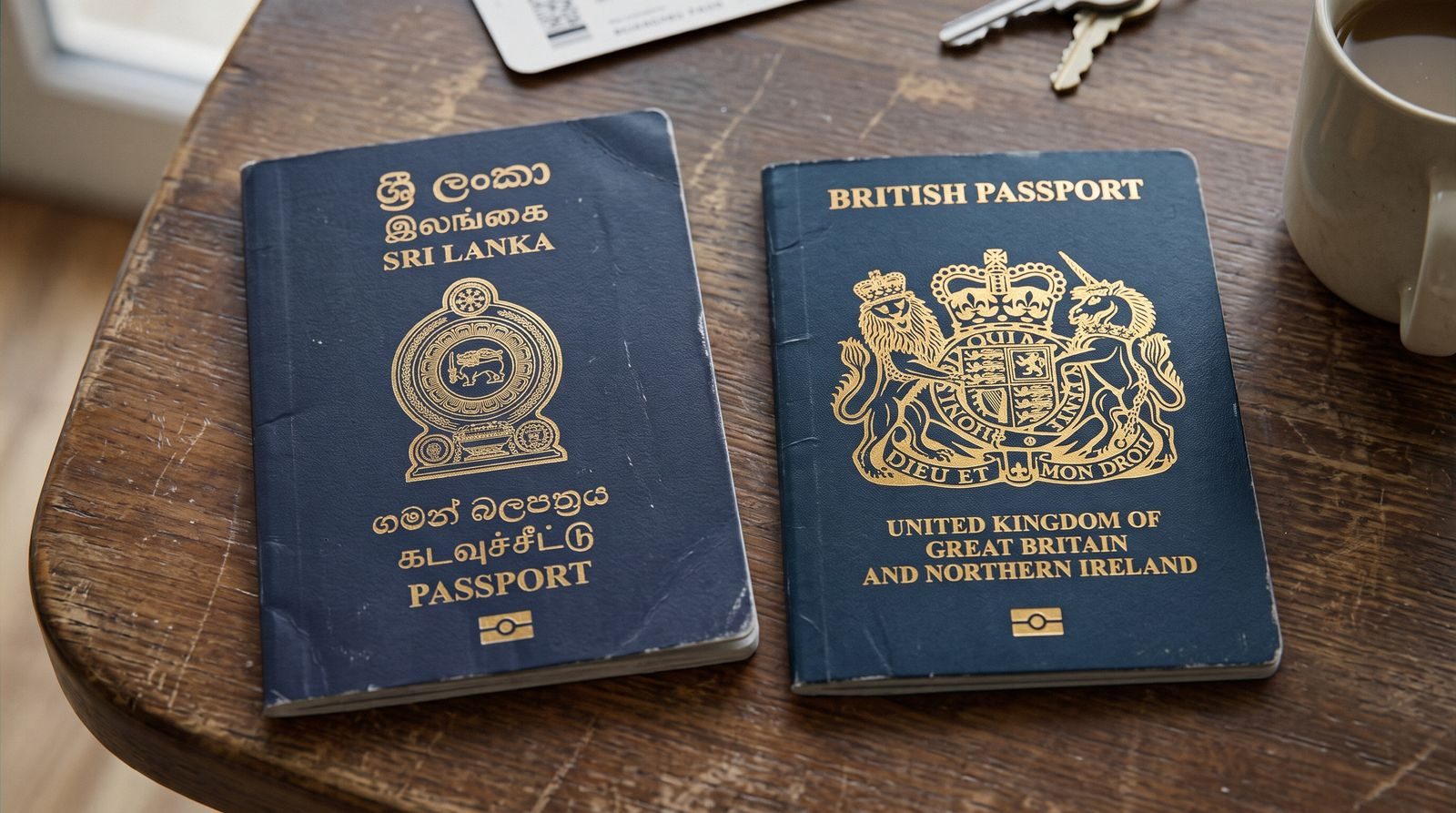
If you became a citizen of another country and lost your Sri Lankan citizenship, or are about to, you may be able to keep or get it back through dual citizenship. This page explains who qualifies, what it costs and how to apply from abroad, based on the Department of Immigration and Emigration's current guidance.
Quick answers
- Resumption is for people who have already lost Sri Lankan citizenship by taking another citizenship.
- Retention is for people about to take another citizenship who want to keep their Sri Lankan citizenship.
- Fees: US$2,000 for the main applicant, US$500 for a spouse and for each unmarried child under 22.
- Apply through the Sri Lankan mission in your country, or at the Head Office in Battaramulla (online from 29 October 2026).
Who qualifies
You must meet at least one of these (as listed by the Department of Immigration and Emigration):
| Category | Requirement |
|---|---|
| A | Aged 55 or over. |
| B | A professional qualification: at least a one-year diploma, or higher. |
| C | Land or property in Sri Lanka worth at least Rs. 2.5 million, with a registered valuer's report. |
| D | A fixed deposit of at least Rs. 2.5 million in an approved Sri Lankan bank, held for 3 years. |
| E | A fixed deposit of at least US$25,000 in an NRFC, RFC or SFIDA account, for 3 years. |
| F | Treasury bonds or a Security Investment Account of at least US$25,000, for at least 3 years. |
| G | The spouse, or unmarried child under 22, of someone who qualifies under A to F. A child's application must be made before they reach 21 years and 6 months. |
Documents you'll need
- Birth certificate (original or certified), and marriage certificate if married.
- For resumption: your foreign citizenship certificate and the main pages of your foreign passport, plus a police clearance not older than 12 months.
- For retention: your current Sri Lankan passport pages, your foreign permanent residence visa, and a police clearance from your country of residence from the last 3 months.
- An affidavit sworn before a Justice of the Peace or Commissioner of Oaths, and three passport photos per family member.
- English translations of any documents not in English.
- If your country isn't on the department's list of countries that allow dual citizenship, a document from that government confirming there's no legal restriction.
Certify copies the right way
- Copies must be certified by a senior officer (Third Secretary or above) at the Sri Lankan mission in the country where you got citizenship, or by the Citizenship Division in Battaramulla. Ordinary notary copies may not be accepted.
Fees (as at 12 November 2026)
| Who | Fee |
|---|---|
| Main applicant | US$2,000 |
| Spouse | US$500 |
| Each unmarried child under 22 | US$500 |
| Certified copies of citizenship certificates | Rs. 2,000 |
Fees are paid in US dollars only after the Minister approves your application. We check these fees every month; always confirm on the Department's website before you apply.
How to apply and pay
- Prepare your documents and get copies certified as above.
- Submit through the Sri Lankan embassy or high commission where you live, or at the Head Office (online application and appointment from 29 October 2026).
- If the Minister approves your application, you'll be emailed to pay the fee in US dollars. Your dual citizenship takes effect from the date you pay.
- You'll be notified by email to collect your certificate.
How long does it take? The Department doesn't publish a processing time, and it varies from case to case, so apply well before you need the certificate.
After you get it
With a dual citizenship certificate and the matching endorsement in your foreign passport, you don't need an ETA to enter Sri Lanka. Dual citizens are also treated as Sri Lankan citizens when buying land; see our Buying property guide.
Long-stay visas if dual citizenship isn't for you
If you don't qualify for dual citizenship, or would rather not apply, the Department of Immigration and Emigration offers visas that let you live in Sri Lanka for longer. Fees are as at 12 November 2026:
| Visa | Who it's for | Validity and fee |
|---|---|---|
| Residence visa: former Sri Lankans and dependants | People whose Sri Lankan citizenship ceased on taking another citizenship, and their spouse and children | 1 year, renewable each year; US$100 a year |
| Residence visa: family members of a Sri Lankan | A foreign spouse of a Sri Lankan citizen (marriage over 6 months) and their children | First issue 1 year and free for the spouse; children US$150 |
| Permanent Residence Visa | People of Sri Lankan descent or whose citizenship ceased; foreign spouses married to a citizen for over 5 years; children under 22 | Up to 10 years; US$1,000 (former citizens, foreign spouses of citizens), US$400 (spouse of a former citizen, each child), plus Rs. 1,000 card fee |
| Digital Nomad visa | Remote workers employed or self-employed outside Sri Lanka | US$500 |
Which one is right for you?
- The residence visa and the Permanent Residence Visa both exist for former Sri Lankans, and the official pages don't say which suits whom. Check your circumstances with the Department of Immigration and Emigration before you apply.
- Many former Sri Lankans find dual citizenship simpler in the long run, especially if they plan to buy land.
Sources
- Department of Immigration and Emigration: dual citizenship
- Department of Immigration and Emigration: online applications notice
- Dual citizenship application status check
- Department of Immigration and Emigration: ETA exemptions notice
- Department of Immigration and Emigration: residence visas
- Department of Immigration and Emigration: visa fees
- Department of Immigration and Emigration: Permanent Residence Visa